Home again!


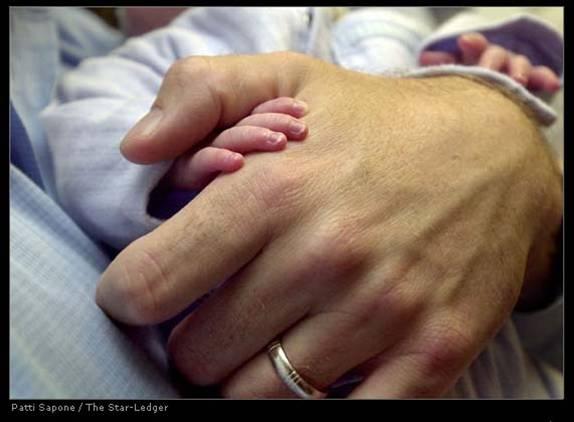
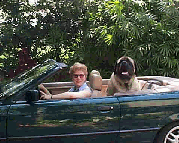
I've been saving this photograph for weeks, in honor of the fun tonight. Yes, despite some misgivings about Halloween, I've decided to turn it into an occasion for celebration, so I sit out on my front porch with the pumpkins and give candy and books to any child who happens by. It's a balmy night here in central Florida, so I'm sure I'll have a few mosquitoes to keep me company. And Charley, of course.

(Charley? My mastiff puppy. The only mastiff I have left and a Very Spoiled Canine.)

Got home from Glorieta last night after eleven p.m. and have spent the day clearing the desk and getting my mind back together. Will have to start writing again soon, but more on that later. Have revisions on MAGDALENE to do, but am waiting for my editor's revision letter (hint, hint.) Oops--here it is!

Back to work,
Angie
By Angela on Monday, October 31, 2005 @ 3:54 PM


for this post

 
Blogger Carrie Says:

You're giving out books?! Yours would have been my favorite house to trick-or-treat at when I was a kid.


Blogger Ruth Says:

Freek AEH books?!! How cool!


Blogger Swan Says:

Giving out books is such a great idea! Nobody ever comes trick-or-treating at my house, though, so I may not get a chance to implement that idea :-(


Blogger Patrica Says:

loved these puppies ...


Add a Comment


Glorieta Christian Writers' Conference


Isn't that picture a HOOT? Love it!

I'm writing from the Glorieta Christian Writer's Conference, which is one PACKED conference for writers! Wow. I'm teaching the fiction track and having a ball with lots of folks who are interested in learning to write novels. Wonderful people with great ideas and a heart to reach people through the printed word.

Also here with novelist friends like Gayle Roper, Jim Bell, Steve and Janet Bly, Brandilyn Collins, Lynn Coleman, and -- ha! Today I looked up in my class and saw Randy Singer sitting in front of me! I have no idea why he thought he needed to come to my class, but now I can say (with a giggle) that I helped teach Randy Singer how to write!

In any case, having a great time and looking forward to two more days and then home. Until then,

Remain in grace,
Angie
By Angela on Saturday, October 29, 2005 @ 8:47 AM


for this post

 
Blogger Patt Says:

Im hungry looking at this picture and im aveggie.Go figure.


Blogger Dianne Says:

Cool! I just saw an ad for that conference the other day and thought I'd really like to attend someday.


Add a Comment


The Thighbone: Send in the Cavalry

(Continued from previous entry)

At the bleakest moment, your character needs help, but be careful how you give it to him. The ancient Greek playwrights used to create such complicated plot knots that no mere human could undo them. The Greeks, therefore, arranged for the gods to drop in and set everything to rights. Characters representing the Greek gods would literally descend from the stage structure above in order to bring the action to a satisfying conclusion.

This sort of resolution is frowned upon in modern literature. The device called deus ex machina (literally god from the machine), is the employment of some unexpected and improbable incident to make the situation turn out right. If you find yourself trotting out a coincidence or a miracle at the bleakest moment, chances are you’ve employed deus ex machina. Back up and try again, please.

I remember reading a wonderful novel that captivated me. At the ending, however, the protagonist was tossed into a pit. As the villain prepared to leave the hero in darkness, he conveniently spilled his guts and explained how and why he had committed his crimes. Then he walked away, leaving the protagonist alone to die.

A few scenes later, the protagonist was sitting in a news conference. He pulled a micro tape recorder from his pocket and pressed play, sending the villain’s voice into the room. The assembled reporters listened as the antagonist confessed everything, allowing the hero to solve the mystery and save the day.

Feeling cheated, I slammed the book shut. The good guy just happened to have a tape recorder in his pocket? How’d it get there? What could have possibly motivated him to pack a tape recorder when he left home that morning?

That trick bothered me even more when I realized how simple it would have been to include a scene where the hero was getting dressed or cleaning out his desk drawer. He could have tossed several things into his pockets—a screw driver, a dried-up ballpoint, a tape measure, a dusty micro tape recorder. As long as the recorder was buried in a list of trivial things, the reader wouldn’t have assigned much significance to it.

More important, readers wouldn’t have felt cheated. When the hero remembered the tape recorder in his pocket, I would have shared that thrill of discovery. I would have identified . . . and that is what you want your reader to do.

At your character’s bleakest moment, you can avoid using deus ex machina if you send two types of help: external and internal.

Your character obviously needs help from someone or something outside himself. If he could solve the problem alone, he would have done it long before the bleakest moment. Having him conveniently remember something or stumble across a hidden resource smacks of coincidence and will leave your reader feeling resentful.

So send in the cavalry—gently. For Dorothy, help comes in the form of Glenda the Good Witch, who doesn’t solve Dorothy’s problem, but reveals a secret—the ruby slippers have the power to carry her back to Kansas. All Dorothy has to do is say “There’s no place like home” with feeling, mind you, and she’ll be back on the farm.

Dorothy’s problem isn’t resolved, however, until she applies this information internally. At the beginning of the story, she wanted to be anywhere but on the farm. Now she has to affirm that the farm is where she wants to be.

Maria’s help comes from the Reverend Mother, who reminds the young postulant that we are not all called to serve God through the church. She advises Maria to search her heart and “climb every mountain” until she finds the dream that will require all the love she can give for the rest of her life.

Maria realizes that she was wrong to run from her responsibilities. The children need her, the Captain needs her. Her goal was to take care of the children, so she must return to the von Trapp estate.

In Mostly Martha, the bleakest moment arrives when Lina’s father arrives. He is a good man, and Lina seems to accept him. But after waving goodbye, Martha goes home to an empty apartment and realizes that she is not happy with her old, empty life. She goes to Marlo, the Italian chef she has begun to love, and asks for his help.

The Kneecap and Leg bone: Make a Decision, Learn a Lesson

Martha has realized that her old controlled life was empty—she needs Lina in her life, and she needs Marlo. And so she and Marlo drive from German to Italy to get Lina.
You may be hard pressed to cite the lesson you learned from the last novel you read, but your protagonist needs to learn something. This lesson is the epiphany, a sudden insight that speaks volumes to your character.

James Joyce popularized the word epiphany, literally the manifestation of a divine being. (Churches celebrate the festival of Epiphany on January sixth to commemorate the meeting of the Magi and the Christ child.) After receiving help from an outside source, your character should see something—a person, a situation, or an object—in a new light.

When the scarecrow asks why Glenda waited to explain how the ruby slippers could take Dorothy home, the good witch smiles and says, “Because she wouldn’t have believed me. She had to learn it for herself.”

The scarecrow then asks, “What’d you learn, Dorothy?” Without hesitation, Dorothy announces that she’s learned a lesson: “The next time I go looking for my heart’s desire, I won’t look any farther than my own back yard.”

Before the bleakest moment, Dorothy wanted to go back to Kansas, but she hadn’t learned to appreciate the home she’d been given. Now she is eager to return.
So even though she is surrounded by loving friends and an emerald city, Dorothy chooses to return to colorless Kansas. She hugs her friends once more, then grips Toto and clicks her heels while murmuring, “There’s no place like home.”

Maria also learns a lesson. After receiving the Reverend Mother’s advice, Maria realizes that running away is not the answer to her dilemma. She decides to return to the von Trapp mansion, to care for the children until another governess can be found. She’s still afraid of loving the captain; she’s still unsure of the future. But she drums up the courage to face her fears and when she is honest about her feelings, the Captain professes an equally strong love for her. Maria’s courage and strength are aptly rewarded.

After enduring several trials at the Miss United States pageant, FBI agent Gracie Hart accepts the title of “Miss Congeniality,” realizing that her fellow contestants are more than dim-witted bimbos. By deciding to embrace her feminine side, Gracie is able to attract and respond to the man she loves.

The Foot: The Resolution

Every story needs the fairy-tale equivalent of “and they lived happily ever after.” Not every story ends happily, of course, some protagonists are sadder and wiser after the course of their adventure. But a novel should at least leave the reader with hope.

Most romances end with the couple falling into each other’s arms or a marriage, the literal combining of two lives. The Sound of Music could have ended with Maria’s wedding and still been a satisfying story; the Nazi subplot was more biographical than integral to the tale.
The Passion of the Christ ends with a wordless scene: a triumphant Jesus coming out of the tomb, his agony ended, his victory over death complete.

At the conclusion of Mary Poppins, the magical nanny opens her umbrella and flies away while the Banks children cavort with their no-longer-workaholic father. Mr. Banks has learned his lesson and decided to go fly a kite with Jane and Michael; Mary’s mission has been accomplished. The Banks family will never be the same.

The resolution to Mostly Martha is portrayed during the closing of the film. As the credits roll, we see Marlo and Martha meeting Lina in Italy, we see Martha in a wedding gown (with her hair down!) and Marlo in a tuxedo, we see a wedding feast with Guiseppe, his family, and Martha’s German friends, we see Martha and Marlo and Lina exploring an abandoned restaurant—clearly, they are going to settle in Italy so Lina can be a part of both families. And in the delightful final scene, we see Martha with her therapist, but this time he has cooked for her and she is advising him.

Many movies end with a simple visual image—we see a couple walking away hand-in-hand, a mother cradling her long-lost son. That’s all we need to realize that our main character has struggled, learned, and come away a better (or wiser) person. As a writer, you’ll have to use words, but you can paint the same sort of reassuring picture without resorting to “and they lived happily ever after.”

Does every story have to have a happy ending? No, though they are undoubtedly popular. Technically, your story should end with a changed protagonist--he or she has gone through this experience and been changed by it. We hope for the better.

Personally, I don't mind a sad ending as long as I am left with a feeling of hope. I ADORED the ending to Titanic because even though Jack died, Rose was forever changed . . . and went on to lead an active, rewarding life that was a far cry from the life she'd have lived if she'd never met him. (The though of Jack surviving, marrying her, and causing her a life of frustration because of his wild ways and gambling habits . . . well, that's much less rewarding, don't you think? VBG.)

And there you have it--the bones of story structure. Use them for plotting or, if you're not a writer, use them to analyze the movies you see and the stories you read. It's fun to peek behind the curtain and discover how things work!
By Angela on Friday, October 28, 2005 @ 10:53 AM


for this post

 
Blogger Carrie Says:

Thank you so much for posting these!


Blogger Lynette Sowell Says:

Great practical examples. I love the analogy ~~


Blogger Patrica Says:

Wow ... some wonderful, thought-provoking words to remember ... thank you!


Add a Comment


The Key to the Story Engine


(Continued from previous entry)

Once you have chosen your main character and given him two needs, you will set him in a specific time and place. This is often referred to as the protagonist’s ordinary world. Usually the first third of a movie and the first few chapters of a novel are involved with the business of establishing the protagonist, his world, his needs, and his personality. The story has not kicked into gear, though, until you move from the skull to the spine, otherwise known as the inciting incident.
In a picture book, the inciting incident is usually signaled by two words: “One day . . .” I’ve written a dozen picture books, and though I don’t intentionally signal the inciting incident, those two words are a natural way to move from setting the stage to the action.

As you plot your novel, ask yourself, “One day, what happens to move my main character into the action of the story?” Your answer will be your inciting incident, the key that turns your story engine.

Let’s look at The Wizard of Oz. In the first act we meet Dorothy and the people in her life. We also meet Miss Gulch, who is clearly an antagonist. Dorothy runs away with Toto, but she’s sent home by the kindly Professor Marvel. If she’d made it back to Uncle Henry and Aunt Em without incident, there would have been no story—or only a very short one. But something happens to prevent the family reunion and Dorothy is literally whisked from her ordinary world to a special place unlike anything she has ever known. The inciting incident? The tornado that picks up Dorothy (and her house) and drops her in the land of Oz.

What is the element of change in Mary Poppins? In this film, the inciting incident is placed right up front; the ordinary world is depicted only briefly. Yes, everything changes in the Banks household when the musical Mary blows into town with a talking umbrella and a bottomless carpetbag. Mary’s arrival moves the family from its ordinary world into a special world. The house is the same house, but with Mary in it, almost anything can happen.

Consider Maria, our misfit postulant from The Sound of Music. She would have continued in her ill-fitting position, doubtless trying to make the best of an uncomfortable situation, but the Reverend Mother receives a letter from Captain von Trapp, who is seeking a governess. The Reverend Mother immediately thinks of her restless postulant and Maria is dispatched to the von Trapp mansion. She leaves her ordinary world, the cozy cloister, for an adventure beyond her imagining.

The inciting incident in Mostly Martha arrives with a ringing telephone. When she takes the call, she learns that her sister, who was a single mother to an eight-year-old girl, has been killed.

But I Don’t Want to Go!

Often—but not always—your protagonist doesn’t want to go where the inciting incident is pushing her. Obviously, Martha doesn’t want to hear that her sister is dead, and she certainly doesn’t want to be a mother. She takes Lina, her niece, and offers to cook for her, but Lina only wants her mother.

Maria accepts the governess position, not because she wants it, but because she’s bound to obey the Reverend Mother. Dorothy is charmed by the Munchkins in Oz, but she doesn’t want to stay in this Technicolor land—she wants to go home.

Think of your favorite movies—how many feature a hero who’s reluctant to enter the special world? At the beginning of Star Wars, Luke Skywalker doesn’t want to rescue the princess. Southern belle Scarlett O’Hara hears about the coming civil war and pooh-poohs the idea; she doesn’t want the cycle of lovely parties and barbeques to end. In The Passion of the Christ, Jesus is in the Garden of Gethsemane, praying that this “cup” pass from him . . . but agreeing that not his will, but God’s must be done.

Even if your protagonist has actively pursued a change, he or she may have moments of doubt as the entrance to the special world looms ahead. In Miss Congeniality, FBI agent Gracie Hart loves her job and would do almost anything to get ahead, but she balks when she’s asked to endure a makeover so she can go undercover at a national beauty pageant.

When your character retreats or doubts or refuses to leave the ordinary world, another character should step in to provide encouragement, advice, information, or a special tool (think Luke Skywalker’s nifty light saber). This will help your main character overcome those last-minute doubts and enable her to establish—

The End of the Spine: the Goal

At some point just before or after the inciting incident, your character will establish and/or state a goal. Shortly after stepping out of her transplanted house, Dorothy looks around Oz and wails, “I want to go back to Kansas!” She’s been transported over the rainbow and learned that the grass really is greener in Oz, but she prefers the tried and true to the unfamiliar and strange. In order to go home, she discovers, she’ll have to visit the wizard who lives in the Emerald City. A

And how does she reach him? By following the yellow brick road.

In a space of only a few lines, Dorothy has stated her goal—to go back to Kansas—and been given a set of subgoals as well. As she tries to meet an ever-shifting set of subgoals, her main goal keeps viewers glued to the TV set.

This overriding concern—will she or won’t she make it home?—is known as the dramatic question. The dramatic question in every murder mystery is Who committed the crime? The dramatic question in nearly every thriller is Who will win the inevitable showdown between the hero and the villain? Along the way the reader will worry about the subgoals (Will the villain kill his hostage? Will the hero figure out the clues? When and where will they meet?), but the dramatic question fuels the reader’s curiosity and keeps him reading until the last page.

Tip: To keep the reader involved until the end, the dramatic question should always be directly related to the character’s ultimate goal.

Martha finds herself trying to care for a grieving eight-year-old who doesn’t want another mother. So Martha promises to track down the girl’s father, who lives in Italy. She knows only that his name is Giuseppe, but she’s determined to find him.

Sent away by the Reverend Mother, The Sound of Music’s Maria picks up her carpet bag and her guitar case and begins the long walk to the von Trapp mansion. Her goal is more sung than stated, more implicit than explicit. When she begins to sing “I’ve Got Confidence,” her flagging voice tells us she’s trying desperately to whip up some enthusiasm for the job. By the time she reaches the outskirts of the von Trapp estate, however, she’s swinging her arms and singing for all she’s worth. Her determination withers at the sight of the imposing family home, but later that night, after she’s met the children, she prays in her room and states her ultimate goal: she will do all she can to bring love, light, and laughter into the lives of these motherless children.

The Ribcage

A story that progresses straight from inciting incident to goal would have a pretty boring plot. Even my third grade students understand that a protagonist who accomplishes everything he attempts is a colorless character. As another friend of mine is fond of pointing out, as we tackle the mountain of life, it’s the bumps we climb on!

If you’re diagramming, sketch a rib cage over your spine, taking care that there are at least three ribs and that the ribs curve gently. These ribs represent the complications that must arise to prevent your protagonist from reaching his goal.

Why at least three ribs? Because even in the shortest of stories—in a picture book, for instance—three complications works better than two or four. I don’t know why three gives us such a feeling of completion, but it does. Maybe it's because God is a Trinity.

While a short story will have only three complications, a movie or novel may have hundreds. Complications can range from the mundane—John can’t find a pencil to write down Sarah’s number—to life-shattering. As you write down possible complications that could stand between your character and his ultimate goal, place the more serious problems at the bottom of the list.

The stakes—what your protagonist is risking—should increase as the story progresses.

In Mostly Martha, the complications center on this uptight woman’s ability to care for a child. Martha hires a babysitter, whom Lina hates, so Martha has to take Lina to work with her. But the late hours take their toll, and Lina is often late for school. Furthermore, Lina keeps refusing to eat anything Martha cooks for her.

Let’s look at the complications Maria faces in The Sound of Music. For the sake of brevity, we can group them into three classes—first, she faces obstacles from the children. The older children don’t think they need a governess; the boys put a pine cone in her chair at dinner. But Maria wins them over with understanding, firm guidance, and complicity in their escapades.

Next, she faces obstacles from the stern Captain von Trapp. The naval commander is horrified to discover his children climbing trees in play clothes made from curtains and he can’t believe Maria refuses to obey his whistle. But because Maria sings a sweet “Edelweiss” and loves the same country (and children) he loves, she wins him over.

Maria’s third complication is the most serious. When I ask my writing students which character represented Maria’s most formidable opponent, most of them mention the rich Baroness who wants to marry Captain von Trapp. But no, though the sophisticated Baroness represents another threat, she’s a red herring. Maria’s toughest opponent is herself. The Baroness points this out when, after discovering the Captain dancing with Maria, she pulls the young postulant aside and says, “You blushed in his arms just now.”

Maria, who has promised her life to the Church, is horrified. How could a future nun allow herself to fall in love with her employer? For Maria, this is the biggest complication of all.

Let’s consider the many complications in The Wizard of Oz. I asked you to make the ribs curve gently because any character that runs into complication after complication without any breathing space is going to be a weary character . . . and you’ll weary your reader. One of the keys to good pacing is to alternate your plot complications with rewards. Like a pendulum that swings on an arc, let your character relax, if only briefly, between disasters.

When Dorothy receives her marching orders from the Munchkins, she sets out upon the spiraling yellow brick road. Soon, however, she reaches an intersection (a complication) and doesn’t know which way to go. Fortunately, a friendly scarecrow is willing to help (a reward).
The scarecrow, in search of brains, joins Dorothy on her quest but they haven’t gone far before Dorothy becomes hungry (a complication). The scarecrow spots an apple orchard ahead (a reward). These apple trees, however, come to life and resent being picked (a complication), but the clever scarecrow taunts them until they begin to throw fruit at the hungry travelers (a reward).

See how it works? Every problem is followed by a reward on a scale commensurate with the seriousness of the complication.

Let’s fast forward. Dorothy finally meets the Wizard (reward) and is told to bring back the broomstick of the wicked witch of the east (a more serious complication with higher risk). On that quest (a sub-goal), she battles winged monkeys, is kidnapped and threatened. But the scarecrow, the tin man, and the cowardly lion, her loyal friends, balance the action by making overcoming opposition and sneaking into the witch’s castle.

Finally we join Dorothy and her friends with the witch. The witch picks up a torch and is about to set fire to the scarecrow (a more serious complication), but Dorothy spots a bucket of water and tosses it on the flame, inadvertently splashing the witch. “Eeek,” the witch squeals, “I’m melting!” (A considerable reward for Dorothy, a considerable complication for the witch).

Dorothy can’t relax yet. She looks up and finds herself surrounded by the witch’s guards (a complication), but they hasten to assure her that they never liked the witch and won’t miss her (a reward). They give Dorothy the nub of the witch’s broomstick and our jubilant traveling party goes back to the Emerald City.

The road ahead should be smooth for our stalwart travelers, but when they appear before the thundering, powerful Oz to claim their rewards, Toto slips away and pulls aside a curtain, revealing that the mighty Oz is nothing but a completely unimposing man (a complication quickly reversed when the man hands out rewards to the scarecrow, tin man, and cowardly lion).

Finally, the wizard assures Dorothy that he can help her. We cut to a scene where Dorothy says her farewells and climbs into a hot air balloon with the wizard. But Toto jumps out to chase a cat, so Dorothy has to jump out to chase Toto, and the balloon takes off without her.

This is a severe complication—it’s so severe it deserves a title of its own: the bleakest moment. This is the final rib in the ribcage, the moment when all hope is lost for your protagonist. Dorothy has no more witches to kill, no more wizards to entreat, no more friends to offer help. She is completely and utterly crushed.

Just like Maria the governess, who realized in her bleakest moment that her own heart had betrayed her.

What does your character need in his bleakest moment?

Next: The End of the Story

By Angela on Thursday, October 27, 2005 @ 10:47 AM


for this post

 
Blogger Cindy Says:

Wow, Angela...those of us who aspire to write fiction are so blessed to have a "seminar" like this, online and free. How wonderful to be able to benefit from your experience and expertise. Thanks for sharing things like this!


Add a Comment


The Plot Skeleton, part 1


Imagine, if you will, that you and I are sitting in a room with one hundred other people. If you were to ask each person present to describe their plotting process, you’d probably get a hundred different answers. Writers’ methods vary according to their personalities and we are all different.

Mentally. Emotionally. Physically.

If, however, those one hundred novelists were to pass behind an x-ray machine, you’d discover that we all possess remarkably similar skeletons. Without our disguising skin, hair, and clothing, we are all composed of skulls, rib cages, femurs, and phalanges. Regardless of the size and shape of our frame, our skeleton supports our body and brains. Beneath the skin, we're pretty much identical.

In the same way, though writers vary in their methods, stories that work are composed of remarkably comparable skeletons. The basic plot skeleton illustrated in this chapter can be found in picture books and movies, plays and films.

Many fine writers have written books about plotting; these writers tend to carefully outline their plots before they begin the first chapter. On the other hand, some of my novelist friends describe themselves as “seat of the pants” writers; they begin to write without an outline or even an ending in mind. But when the story is finished, a seat-of-the-pants novel will (or should!) contain the same elements as a carefully-plotted book. Why? Because novels need structure beneath the story. Whether you plan it from the beginning or find it at the end, novels need a plot skeleton.

For many years I used Gary Provost’s brief “formula” for plotting, then I became aware of Christopher Vogler’s wonderful book, The Writer’s Journey. His plot structure, based upon the mythical “hero’s journey” was more involved than Provost’s, so his formula helped me complicate my plots. But while I was forcing my characters to jump through the hoops of the hero’s journey, I was invited to join the faculty of the Young Writer’s Institute and teach children about writing.

In short, I needed a plot formula simple enough for eight-year-olds.

After mulling several plot designs and boiling them down to their basic elements, I developed what I call the “plot skeleton.” When I teach plotting to children (and adults), I draw a cute little skeleton on the board, then illustrate how his bones correspond to elements that should be found in any story. After teaching my skeleton for a while, I realized that it is flexible and strong enough to accommodate anything I might want to write.

When I sit down to plan a new book, the first thing I do is sketch my smiling little skeleton.

Dem Bones, Dem Bones

To illustrate the plot skeleton, I’m going to refer frequently to movies we’ve probably all seen, particularly The Wizard of Oz and The Sound of Music. I’m also going to mention a lovely foreign film you may have never seen, Mostly Martha. It’s worth the rental.

The “skull” of my skeleton represents the main character, the protagonist. Even in an ensemble cast, one character should be featured more than the others. This helps with reader identification—your reader wants to place himself into your story world, and it’s helpful if you can give him a sympathetic character with whom he or she can relate.

This main character should have two things, which I represent by two yawning eye sockets.

What two things? Two needs: one obvious, one hidden.

Let’s see how this breaks down in a few movies. Who’s the main character of The Wizard of Oz? Dorothy, obviously. Who’s the main character of The Sound of Music? Maria, the young postulant. Who’s the main character of Mary Poppins?

If you’re like the majority of my writing students, you missed that one. Most people answer “Mary Poppins,” and while she is undoubtedly the star of the movie, she’s not the main character of the story. Why not? Because she has no needs. This is rather succinctly indicated in a scene that takes place after her arrival at the Banks’ house. Mary pulls her tape measure from her carpet bag and measures herself. The reading given by her magical tape is “Mary Poppins, practically perfect in every way.”

A perfect character rarely has needs. So—which character in that film has an obvious and a hidden need at the beginning of the story? The children need a nanny, true, but they’re not the main character. Mrs. Banks is a little too distracted by her suffragette activities to even pay attention to the plot. Who’s left? Mr. Banks, Jane’s and Michael’s father.

At the opening of the film, Mr. Banks has an obvious need—his children’s nanny has departed and he needs someone to fill her shoes. His hidden need (which is depicted without being remarked upon) is to learn how to be a father to his children. At the beginning of the film, he is far too busy with his work at the bank to notice Jane and Michael.

Here’s a tip: hidden needs, which usually involve basic human emotions, are always solved or met by the end of the story.

Think back to The Wizard of Oz. What is Dorothy’s obvious need at the beginning of the film? Miss Gulch has arrived to take Dorothy’s dog, Toto, because he bit Miss Gulch’s scrawny leg. Dorothy needs to save her dog.

What is Dorothy’s hidden need? Think about what is depicted but not directly emphasized in the scene where she stands by the pig pen and sings “Somewhere Over the Rainbow.” Dorothy is longing for a place, any place, but the farm. We know she is living with her Uncle Henry and Aunt Em. Do children live with their aunt and uncle if all is fine with Mom and Dad? No. So though we are not told what happened to Dorothy’s parents, it’s clear that something has splintered her family and Dorothy’s not happy about it. Her hidden need, then, is to find a place to call home. This is the need that will be met by the end of the story.

What about the feisty nun-in-waiting, Maria, from The Sound of Music? Her obvious need at the beginning of the film is simply to fit in at the convent. She’s the proverbial square peg trying to fit into a round hole. The other nuns love her, but she can’t seem to adapt to the convent’s quiet, scheduled lifestyle.

Her hidden need? We see her opening her arms wide on the mountaintop; we hear her singing of a heart that wants to sing every song it hears. By implication we understand that this is a woman who doesn’t gargle at the fountain of life—she guzzles. Her song also tells us that she goes to the hills when her heart is lonely, so apparently the cloistered life is not meeting her emotional needs. Yet she was driven to go there, and people don’t volunteer to become nuns unless they love God passionately and want to serve Him.

Maria’s hidden need—which the astute Reverend Mother will recognize—is to love deeply, serve fully, and taste many life experiences. By the end of the movie, this need is met.

Mostly Martha opens with the title character lying on her therapist’s couch and talking about all that is required to cook the perfect pigeon. Since she’s in a therapist’s office, we assume she has a problem, and the therapist addresses this directly when he asks her, “Martha, why are you here?”

“Because,” she answers, “my boss will fire me if I don’t go to therapy.”

Ah—obvious problem at work with the boss. Immediately we also know that Martha is high-strung, and this is supported when we see her at work in her kitchen. She wears her long hair tied back in a bun, she is precise and politely controlling in her kitchen. This woman lives for food, but though she assures us in a voice over that all a cook needs for a perfectly lovely dinner is “fish and sauce,” we see her venture downstairs to ask her new neighbor if he’d like to join her for dinner. He can’t, but we are aware that Martha also needs company.

And love, of course.

Note: writers are often told to begin the story in media res, or in the middle of the action. They assume this means they need to begin the story in the midst of the Big Incident that's going to happen. Not necessarily. Just start things in an obvious problem--that'll give you action plus, given the nature of the problem, tell us something about the character. We learned that Dorothy loves Toto passionately, that Maria is a one-in-a-million gal, that Martha is a perfectionist chef. Yes, start in the middle of something active, but you can hold off on the big event for a while. Let us get to know your character first . . . because we won't care about them until we know them.

Tomorrow: Connecting the character to the story
By Angela on Wednesday, October 26, 2005 @ 10:41 AM


for this post

 
Blogger Cindy Says:

Angela, did you know that Catherine Zeta Jones will star in an English-language version of "Mostly Martha"?


Anonymous Angie Says:

No, I didn't know that! How fun! Thanks for the heads up!

Angie


Blogger Louise Bergmann DuMont Says:

I was in your Fiction A-Z class at Glorieta and I'm using your plot skeleton to work on my next book. Thank you for all the great info. Your presention was not only informative but lots of fun. I do have one question. You let us briefly look at an excel spred sheet that you use to map-out your books. Is a list of what you include in that spread sheet anywhere on the web?
Blessings, Louise Bergmann DuMont


Add a Comment


Heading to New Mexico . . . and teaching


First things first--happy birthday to my Mom!

I'm heading out tomorrow for Glorieta, New Mexico, and since they only have dial-up at the retreat center, I'm going to pre-write several blog posts and hope I'll be able to click "send" every day.

Since I'm heading off to teach the fiction track, I thought I'd share what I've developed to teach writers of all ages about plotting. Now--I know about Randy's snowflake and Vogler's The Writer's Journey. I've read tons of books, and my skeleton isn't necessarily a tool for plotting, though I've had great success in using it for that purpose. You can use it merely as a tool for analysis, if you like. (Recently I got stumped in MAGDALENE and forced myself to stop and sketch out the skeleton. Almost immediately I found my story problem--the bones weren't fitting together properly.)

Anyway . . . people who call themselves "seat of the pants" writers relish the joy of being free to discover new things in the process of writing. But I can't sit down without an outline; the very idea of not knowing where I'm going scares me spitless. I need a destination or I know I'll wander all over the place, and I can't stand the thought of wasted effort. On the other hand, writers who plot out every single development before hand--well, I'd find that too limiting. I need the freedom to listen to the characters because they come to life as I work with them. I don't know all their secrets in the first draft. I have a much better handle on things by draft three.

So--I came up with the plot skeleton. It's bare bones on purpose. It will give you a basic, solid structure without limiting your desire to add additional things. And it's simple enough for a third grader to understand.

The other day I realized that all of us were (or should have been taught) how to construct a five-paragraph theme in high school. You know, the old intro, thesis sentence, three main points, conclusion. I wrote more of those than I care to remember.

Yet we were also often told to "write a story" and I don't remember EVER being given clear directions or any kind of blueprint. I think our teachers thought that anything would be okay and frankly, it isn't. Fiction needs a structure, too. (If it's going to hang together properly, that is.)

So, beginning tomorrow, I'm posting a mini-workshop on plotting. Enjoy.

Angie
By Angela on Tuesday, October 25, 2005 @ 10:25 AM


for this post

 
Anonymous Anonymous Says:

Thank you, thank you, thank you, thank you!!!!!!!


Blogger Carrie Says:

Can't wait!


Anonymous Betsy Says:

That is an answer to a prayer


Add a Comment


Reading and Writing . . .

. . . go hand in hand.

People always ask if I've always wanted to be a writer, and I say no. But then I quickly admit that I've always been a reader. Am still reading Jane Smiley's 13 Ways, and I loved what she said about novelists and reading. An excerpt:

"While the desire to write a novel does not guarantee that the resulting novel will be a good one . . . it is the only way to begin. Most often it grows out of a compulsive habit of reading as a child . . .

"We were reading because it was easy and fun and because we were unsupervised. We were reading to find companions more congenial than those around us. We wanted to fill our heads with nonsense and tune out practical considerations. We were not, most likely, athletic or useful sorts of children. We were reluctant to help around the house or to go outside and play. We did not have very good manners, because in numerous ways . . . reading books is deleterious to good manners. We did not have good sleep habits, because if we had, we would not have read under the bedcovers with a flashlight, or held the book up to the moon that shone through the window, and ruined our eyes."

And this is the best part:

"We were reading because we had two lives, an inner life and an outer life, and they were equally important to us and equally vivid. A novelist is someone whose inner experience is as compelling as the details of his or her life, someone who may owe more to another author, never met, than to a close relative seen every day. A novelist has two lives--a reading and writing life, and a lived life. He or she cannot be understood at all apart from this."

Well said, Jane.

Angie
By Angela on Monday, October 24, 2005 @ 9:59 AM


for this post

 
Blogger Cindy Says:

Wow...I agree totally. Great quote.


Blogger Carrie Says:

She described me as a child to a "T". I have to read that book.


Blogger Gina Holmes Says:

Thanks for the smile. That was sweet...and true.


Add a Comment


The Perfect Haircut


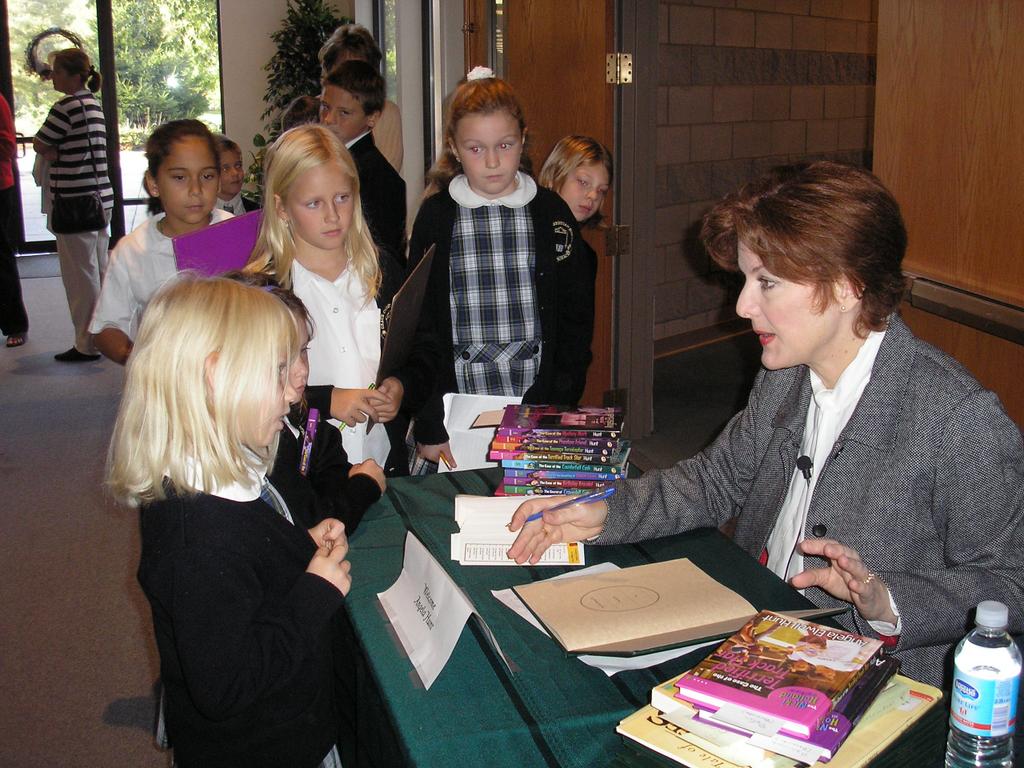
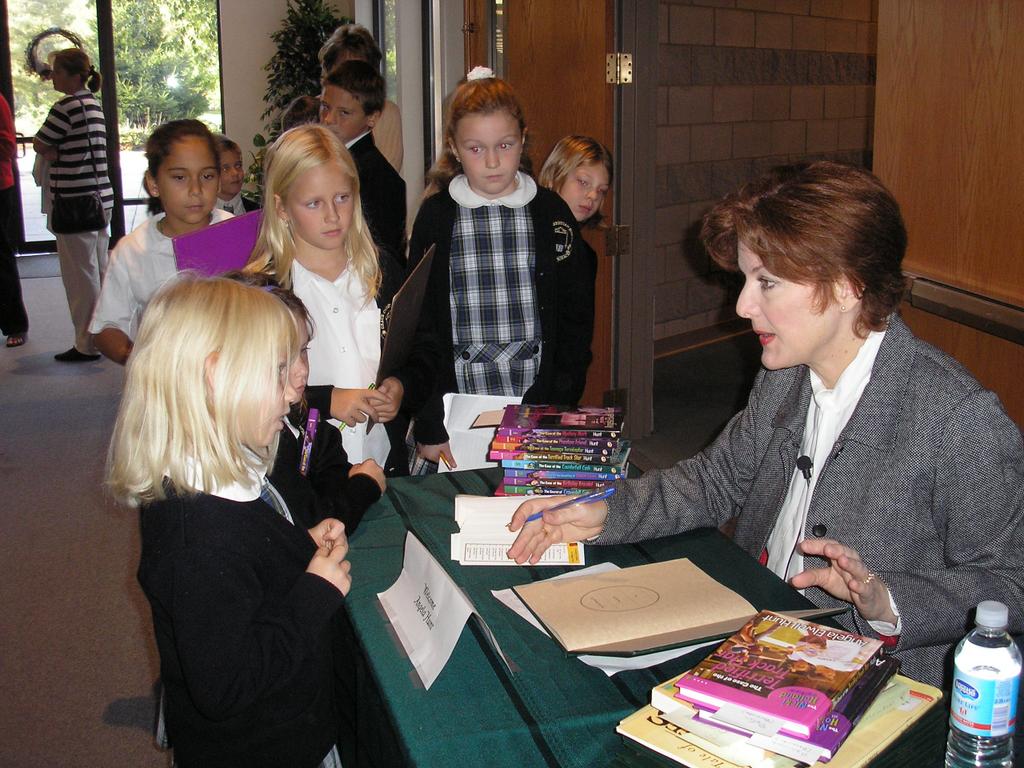
Photo: signing books for students at the wonderful Grace Christian School in Ohio. With the new haircut.

I've recently discovered what every woman dreams of: a hair-cutting genius. (With apologies to all the hairdressers in my past. You were great, but my latest experience just struck me as a perfect metaphor.)

The genius's name is Rob, and I'd tell you the name of his salon, but then I'd never be able to get in--he's already very busy. The difference with Rob, you see, lies in the fact that he looked at my head, my hair, and the shape of my face--all those things we're told to pay attention to--and then he told me what he was going to do.

My problem, he said (I'm paraphrasing; he was much more diplomatic) is that I have too much hair. I knew this. So he was going to remove all the hair above and behind my ears and at the nape of my neck.

Remove my hair? Images of bald flesh and itchy stubble flashed before my eyes, then Rob assured me he wasn't actually going to shave my head. But remove the excess hair, yes. The result would be hair that kept its shape, flattered my head, and did not look like an overgrown ligustrum bush.

So I trusted myself to Rob's scissors and didn't even wince when he cut the air around and behind my ears shorter than the length of a pencil eraser. Thank heaven, I couldn't see what he was doing at the back of my head. And you know what? I walked out of that salon with hair that was easier to dry, style, and actually looked good on this aging head.

The metaphor part? Writing is like that. Sometimes you have to have the courage to remove pages, scenes, chapters, and extraneous words. Clip, clip. Snip, snip. The result is a tighter, leaner book.

The other day, in her Charis post, Liz Higgs mentioned the practice of saving deleted scenes and chapters in a computer file to ease the pain of separation. I've been doing this for some time. Some of the good material will find its way to my web page, like the deleted scenes on a DVD. The simple and unnecessary words can vanish from sight, and good riddance.

Ah. When in doubt, cut it out. Works for me!

Shalom!

Angie

By Angela on Sunday, October 23, 2005 @ 6:30 AM


for this post

 
Anonymous Melissa Says:

I love your haircut!If you've seen the movie "Beaches" there's a line that Bette Midler states... "Hate my hair!" I laugh every time I watch the movie because it resonates my thinking about my own hair manymany a times. Is your hair naturaaly red? I know I have a picture where it was more of a strawberry blonde...


Anonymous Melissa Says:

sorry about my spelling. I took my eyeglasses off to rest my eyes after a long day at work...and reading the post before previewing it,I can tell the difference. LOL


Blogger Anna Says:

What a great picture -- love the expression, and hair looks fabulous, too.


Add a Comment


Jesus is My Boss . . . what does that mean?


Ever been this tired? LOL.

I've been traveling a lot lately and speaking to elementary and middle school students about life, God, and writing. There's a line in my standard speech that goes like this:

"When I was six years old, I gave my life to Jesus. And I knew what it meant, and I knew what I was doing, and I knew that from that day forward, Jesus was to be the boss of my life."

All true. But--lately, as I've fielded questions about my goals and dreams, I find myself wondering if I even have a right to goals and dreams. Oh, I know that sounds unAmerican. Unnatural. But, if we really think about it, if you surrender your life to Christ, doesn't that mean the right to those goals and dreams belongs to him?

The premise of my standard school speech is that I never dreamed of being a writer--and that's true. But God led me down some interesting paths to bring me where I am today. Expect the unexpected? For sure I never expected to be here. But God is good, and though I haven't been perfect, I really have tried to let him dream and plan for me.

So . . . what are my dreams? Well, it'd be nice to have a best seller and to retire in North Carolina and hold a grandbaby or two, but that's okay--I'm not set on any of those things. It's enough to face each day with the hope and prayer that I'll fulfill HIS dreams and plans for my day . . . nothing more, nothing less.

I'm about to make a huge decision that will affect the next few years of my life and career. So it's a good thing the Lord has brought this to my mind lately. It's not about me, my career, promotion of my books. It's all about him. Whatever he wants . . . and can I say that even if his plan includes a book that bombs?

Big breath. That, my friend, is the challenge of the Christian writer's life.

P.S. Happy birthday to my sister, Gay.

Angie
By Angela on Saturday, October 22, 2005 @ 6:13 AM


for this post

 
Blogger Gina Holmes Says:

Angie, great post. And thanks for plugging my site yesterday. You were a huge hit! The strange artistes loved you. I love your attitude about accomplishing what God has for you each day, no more, no less. It is so awesome to be in His hands. I had an unexpected blow the other day. I freaked for a few minutes (many a bit longer :) and then remembered God has a plan for me. A better plan than I could imagine for myself. I got over the shock and said, "God, what do you have up your sleeve?" Ain't be in His capable hands grand?
I'll say a prayer about your big decision. That you get a clear answer from above. Blessings to you!


Anonymous Anonymous Says:

I've had the same thoughts on my mind lately. And I keep thinking of the lyrics to an Avalon song . . . the chorus (sung from God's perspective): "These dreams I dream for you are deeper than the ones you're clinging to; more precious than the finest things you do; and truer than the treasures you pursue. Let the old dreams die like stars that fade from view, and take the cup I offer and drink deeply of the dreams I dream for you."


Add a Comment


Visiting Another Blog Today . . .


I've been visiting . . . . and http://www.firstnoveljourney.blogspot.com/ . . . is where I popped into do an online interview. Gina Holmes kindly invited me to spout off, so I did. I just hope I don't sound like a woman with chronic PMS.

So . . . if you'd like to pop over there and take a read, be my guest. And let me know you stopped by, okay?

Thanks!

Angie
By Angela on Friday, October 21, 2005 @ 8:04 AM


for this post

 
Blogger Ruth Says:

Excellent interview!


Blogger Gina Holmes Says:

I popped in, does that count? :)


Add a Comment


Jane Smiley Quote


I adore this quote from Jane Smiley's book: "If to live is to progress, if you are lucky, from foolishness to wisdom, then to write novels is to broadcast the various stages of your foolishness."

Ah . . . that is so profound I am experiencing an urge to go sit in the closet and perhaps never come out.

Angie
By Angela on @ 7:34 AM


for this post


New books, new books


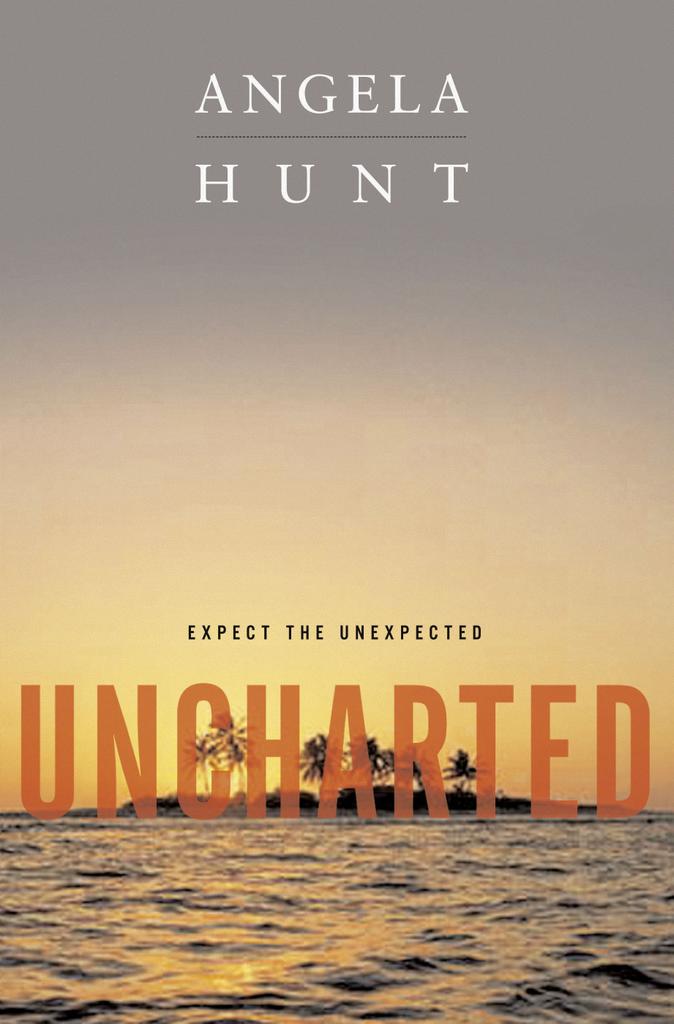
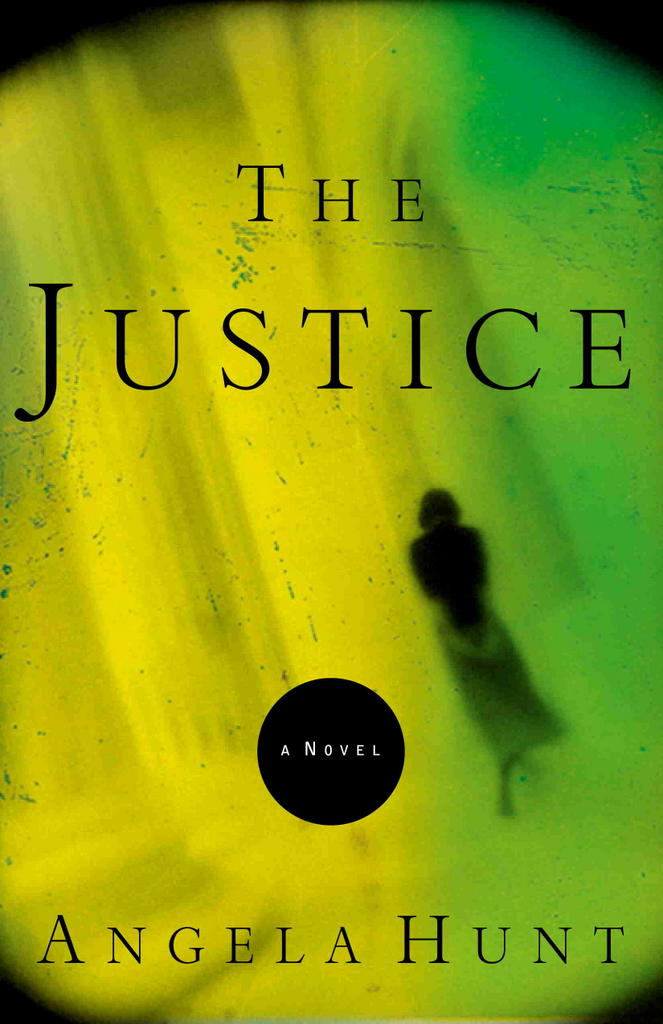
Ah, a red letter day. If you hold to the analogy that a new book is like a new baby, then the picture at the left is my first sonogram. (VBG). The cover of UNCHARTED, due out in June 2006. What's it about? I like to describe it as "LOST" meets "The Big Chill."

And there are two other new books on my desk. The first is a nonfiction book called Not In Kansas Anymore: A Curious Tale of How Magic Is Transforming America. I've not yet read it, but after a quick skim, I'm thinking it should be called How America Is Trying to Trust Anything and Everything but God.
I'm thinking about setting it out for my book club; should make an interesting faith-discussion. It also looks like it'd be helpful for anyone who writes about the occult, etc.

The other new book on my desk is Jane Smiley's 13 Ways of Looking at the Novel. Now this is a book to ponder--it looks so dense and lush that I think I'll be doing well to read/digest a chapter a day--or even half a chapter. Can't wait to dig into it.

Well, this is "telephone day"--for some reason I have scheduled four telephone appointments today: two conference calls and two long-distance book clubs. I'm so rarely on the telephone, this will be interesting! And tonight--Alias! I certainly hope this season five picks up. So far it's been a bit of a snooze, but I'll hang in there for at least a while.

Shalom!
Angie
By Angela on Thursday, October 20, 2005 @ 9:34 AM


for this post

 
Anonymous Anonymous Says:

I am actually a fan of yours. I don't have my own blog site. I actually would not even know how to begin one. My former pod partner is a Wiccan and she is really into it. What is so compelling of where it is taking place. I live in a state that has been called the Vatican of the West. She states Wiccan is #2 for growth in this state. I am thinking she is exaggerating the growth. I got my Crossings catalog one of the books is called Bewitched. It talks about how Wiccan is the fastest growing religion across college campuses. What blew me out of the water was she said one of her coven members calls herself a New Age Christian. I belong to a faith that is rarely considered "Christian." It rarely bothers me because I know who to look to for my redemption and it is his blood that cleanses me. I guess what alarms me the most is my faith is known for its ability to share the message of their faith. They have nothing on the Wiccans ability to bring new members in. I have personally witnessed in the short amount of time she had been on my team. She had brought three other women on my team into her coven. This is a faith that seduces. I think this is a faith that cannot be taken lightly. One of the first things she told me Satan is not real. She then tells me it is something Christians made up. It is a frightening thing to be this up close and personal and witness it.


Add a Comment


Go ahead, take a sip!


It has occurred to me that lots of folks who pop into this blog have never read one of my books. That's rather like hanging around Starbucks to use the wi-fi and breathe in the delicious aroma without ever taking a sip, don't you think? But never mind, no sour grapes here. Honest. In fact, I am offering--and have always offered--a free book to anyone who wants one. All you have to do is pony up for the postage and the fancy padded mailer. My cluttered garage will thank you.

If you'd like a free book, visit this link www.angelaelwellhunt.com/clearance.htm and click on the "free book" button. So simple. Leave your postage/padded envelope deposit with PayPal, and I'll get your free book right out to you.

BTW, I think my web hosting company's server has been on the fritz. So if the link is slow or inoperative today, try again tomorrow. I've used them for years without a problem, but Mr. Murphy always seems to show up . . .

Shalom!

Angie

By Angela on Wednesday, October 19, 2005 @ 4:37 PM


for this post

 
Blogger Ruth Says:

Coming from someone who's been a fan of Angela's since I first read the Theyn Chronicles ten plus years ago, TAKE HER UP ON HER OFFER!! Her books are AMAZING!!!


Add a Comment


Flying to Philly

Actually, I'm not going to Philly at all, I just like the alliteration. I'm on my way to Savannah, and I suppose I ought to be grateful--came here without a seat, but I've just seen my name shot up on the "cleared" list, so I suppose they found room for me. So I'm sitting here on the floor, legs out, laptop on lap (alliteration again!), and I'd say "arms akimbo," but they're not. Ever notice how many romance writers use the word "akimbo"? And "splayed." And "hunker down." Take out your highlighter the next time you read a romance, and you'll see what I mean.

I suppose we all have our habits. I remember once I was writing a very action-oriented series, and no one could pick up an AK-47 machine gun without "slamming the cartridge home." And no one could turn on a computer without it "whirring and lagging" in response. We all have our pet phrases, and usually by the time we recognize them, it's time to kill them off. Big sigh.

Tomorrow I'm speaking in at least one Savannah Christian school, then home before dark, I think. I hope. And home the rest of the week. :-) I'm having the grout cleaned, the exterminator is coming (found evidence of rats in the attic yesterday as I pulled down the tin pumpkins.)

Well, time to board ze plane, ze plane.

Peace.
By Angela on Monday, October 17, 2005 @ 3:34 PM


for this post

 
Blogger Yong-Yong Says:

Hi!
I came across your books at a local library, and I enjoy all of the ones that I have read so far. I visited your website (which lead me to your Blog), but unfortunately there isn't an "About the Author" page. I would like to get to know more about the author behind these brilliant books, not only because I want to, but also because I am writing a report on two of your books...and one of the requirements for the reports is to briefly write about the author.


Blogger Angela Says:

Chloe, try the "How I Became a Writer" page under "services" . . . I think.

Angie


Blogger Ruth Says:

Angela, this blog made me smile...so true! Have a blessed day!


Add a Comment


Home and Epiphany


I'm home again. (I'm leaving again tomorrow, but only for a day trip.) And since I've been home, I've had an epiphany of sorts: People think writers are unusual people.

Know what else I've noticed? Some writers want to be unusual people. They talk about how strange they are, as if strangeness is a quality to be cultivated. Well, I've got news for you--I have about a hundred close writer friends, and they're not strange at all. You could have dinner with any one of them in a public place and no one would stare at you . On the other hand, I took my daughter to art school a couple of years ago, and I stared at everyone in attendance. You want to know strange, get thee to an artists' colony.

Maybe, you say, I don't notice that my novelist friends are strange because I'm strange. But I still beg to differ. Every been to a dentists' convention? Hung out with circus folk? Gone "backstage" at a dog show? If you've done any of the above, you'll realize that everyone is strange in their own way. And when like minds congregate, the strangeness shows.

But when writers cultivate the quality of oddness, I think we make writing seem altogether too mystical, as if mere mortals can't possibly aspire to it. Blarney and poppycock. Anyone with the gift of sitting still can learn to write. They may not be artistic about it, but if they can speak and think, they can write. Written communication is not rocket science.

One of my favorite writing books is Dare To Be a Great Writer by Leonard Bishop. I've had this book for years and never tire of flipping through the assorted entries. But one entry, I think, was written entirely tongue in cheek. Bishop says that once you have become a best-selling author, you need to develop a persona; you need to cultivate the writer's mystique:

"No longer have casual conversations. Conduct orations. Not with passive platitudinous ponderosities, but with dynamics and charm. Use the body language of a shadow-boxing pugilist. Develop cunning facial expressions. Grimace as though pained with profundity. Wink, pout, sigh, crack your knuckles in contemplation. Use a repertoire of snappy jokes employed by any popular dentist. Be direct, outspoken, bold. Do not become subtle or ethereal with implication. Audiences are not talented at grasping existentialist innuendo. Rehearse being extemporaneous. "

I respond to the above with a ROFLOL. And while I'll admit that my ten presentations at schools this past week contained a LOT of body language, acting, and humor (two girls from one school dubbed me the 'drama queen'), most of that was just to make sure my audience remained awake.

Yes, writing requires a lot of hard work. Writing a good novel takes hard work and endless hours. Writing an artistic novel takes even more time. Writing an artistic novel that doesn't put people to sleep requires even more effort. Few folks commit to that level of sacrifice.

But there are surgeons who strive for that level of excellence in their field . . . and teachers who aim for excellence in order to influence young lives. And broadcasters and mothers and fathers and architects and pastors and dog groomers, all of whom have committed their lives and their careers to excellence for the glory of God.

Does that make them strange? In a sea of mediocrity, perhaps. In the light of eternity, they're not strange at all. They're the called, the committed, the good stewards. The ones who will hear "Well done, good and faithful servant."

I aspire to be one of them . . . but I don't think that makes me strange. Just . . . called.
Angie
By Angela on Sunday, October 16, 2005 @ 2:12 PM


for this post

 
Anonymous Anonymous Says:

...and what a wonderful job you are doing at your calling! I'm grateful God gave you the gift you have. You do have to admit, though, you are a lot of people's FAVE author and we think you're a genius at what you do. I'm wondering if you might think us strange...I met you once at a Women of Faith conference and just stared at you. It was an awkward moment. I was starstruck...hehe. Anyways, I'm glad you are doing this blogging thing. It's great to peek into your life and realize you are actually pretty normal. :)


Add a Comment


Reporting from Ohio


Another busy day, but a bonus--a night off! I was supposed to speak in a church tonight, but something happened, so I'm tucked in with room service and in my jammies. Another full day tomorrow--two schools and a bookstore in the p.m.

I'm still talking about my dogs with the kids, so that's Justus with a pup I puppy-sat one afternoon. Jussy was so gentle with small things! I remember him once catching a squirrel and carrying it around the yard as it screamed for its life. Not knowing what else to do with it, he came inside and dropped it in the pool, where Sadie couldn't get it. LOL.

Sadie and Jussy are both gone now, but I still smile at the memories.

This morning I spoke in chapel and did a workshop at Polaris Christian Academy; this afternoon I did the same thing at Genoa Christian Academy. Both schools were super, with great students and a wonderful, supportive staff. I also gave a pitch for the Nelson School Enrichment Program at a luncheon for ASCI school administrators.

Well . . . time to sign off and get some shut eye after calling home to check in. Two more days and then I'm home!

Angie

By Angela on Wednesday, October 12, 2005 @ 8:13 PM


for this post